
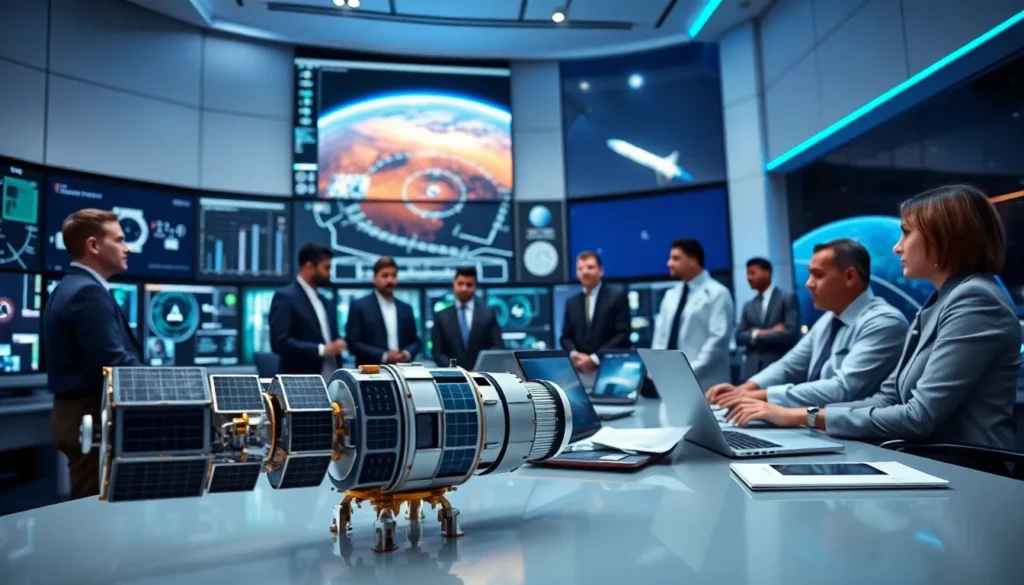

Space technology techniques have transformed how humans explore and understand the universe. From satellite systems orbiting Earth to spacecraft venturing into deep space, these innovations continue to push boundaries. Engineers and scientists develop new methods each year to solve challenges that once seemed impossible.
The space industry relies on a diverse set of space technology techniques to achieve its goals. These include advanced propulsion systems, autonomous robots, life support equipment, and communication networks spanning millions of miles. Each technique plays a specific role in making exploration safer, faster, and more efficient.
This article examines the key space technology techniques driving modern exploration. Readers will learn about satellite communication, spacecraft design, robotic systems, and human spaceflight technologies. Understanding these methods reveals how humanity continues its journey beyond Earth.
Table of Contents
ToggleKey Takeaways
- Space technology techniques encompass satellite communication, propulsion systems, robotics, and life support to enable safer and more efficient exploration.
- Ion propulsion and reusable rockets represent major advances that reduce costs and expand mission possibilities for deep space travel.
- Autonomous navigation allows robotic explorers like NASA’s Perseverance rover to make real-time decisions without waiting for Earth commands.
- Remote sensing satellites support critical applications including weather forecasting, disaster response, GPS navigation, and climate monitoring.
- Life support systems on the International Space Station recycle approximately 90% of water, reducing dependency on Earth resupply missions.
- Advanced space technology techniques will be essential for future long-duration missions to Mars, where crews cannot rely on emergency returns.
Satellite Communication and Remote Sensing
Satellite communication forms the backbone of modern space technology techniques. Spacecraft and ground stations exchange data through radio signals that travel across vast distances. This communication enables mission control to send commands and receive scientific data in near real-time.
Remote sensing satellites gather information about Earth and other celestial bodies without physical contact. They use various sensors to detect electromagnetic radiation, including visible light, infrared, and radar signals. NASA’s Landsat program, for example, has collected Earth observation data since 1972.
These space technology techniques serve multiple purposes:
- Weather forecasting and climate monitoring
- Agricultural planning and crop health assessment
- Disaster response and emergency management
- Military reconnaissance and surveillance
- Navigation through GPS and similar systems
Modern satellites can achieve data transmission rates exceeding 1 gigabit per second. SpaceX’s Starlink constellation demonstrates how thousands of small satellites can provide global internet coverage. This approach differs significantly from traditional geostationary satellites positioned 35,786 kilometers above Earth.
The development of optical communication represents an emerging space technology technique. Laser-based systems transmit data at higher rates than radio frequencies while using less power. NASA’s Laser Communications Relay Demonstration launched in 2021 proved this technology works in operational conditions.
Propulsion Systems and Spacecraft Design
Propulsion systems determine where spacecraft can go and how quickly they arrive. Chemical rockets remain the primary method for launching payloads from Earth’s surface. These engines burn fuel and oxidizer to produce thrust through Newton’s third law of motion.
Ion propulsion represents one of the most efficient space technology techniques for deep space missions. Instead of burning fuel, ion engines accelerate charged particles using electric fields. NASA’s Dawn spacecraft used ion propulsion to visit the asteroid Vesta and dwarf planet Ceres on a single mission.
Spacecraft design has evolved dramatically over decades. Engineers now use lightweight composite materials that reduce launch costs while maintaining structural integrity. The James Webb Space Telescope features a sunshield made from five layers of Kapton, each thinner than a human hair.
Key propulsion and design innovations include:
- Reusable rocket boosters (SpaceX Falcon 9 has landed over 200 times)
- Nuclear thermal propulsion for faster Mars transit
- Solar sails that use photon pressure for propellantless travel
- 3D-printed engine components reducing manufacturing time
These space technology techniques directly impact mission feasibility. A spacecraft traveling to Mars using chemical propulsion takes approximately seven months. Advanced propulsion could reduce this journey to three or four months, decreasing radiation exposure for astronauts.
Modern spacecraft also incorporate autonomous systems that handle routine operations. This reduces the workload on ground controllers and allows faster responses to unexpected situations.
Robotic Exploration and Autonomous Navigation
Robotic explorers have visited every planet in our solar system. These machines travel to places too dangerous or distant for humans. They collect samples, take photographs, and transmit data back to Earth over periods spanning years or decades.
Autonomous navigation counts among the most critical space technology techniques for robotic missions. Signal delays between Earth and Mars can reach 24 minutes one way. Rovers cannot wait for instructions when avoiding obstacles, so they must make decisions independently.
NASA’s Perseverance rover demonstrates advanced autonomous capabilities. Its AutoNav system analyzes terrain using cameras and selects safe paths without human input. The rover travels up to 120 meters per hour, significantly faster than previous Mars vehicles.
Robotic space technology techniques include:
- Sample collection and storage mechanisms
- Self-diagnostic systems that identify hardware problems
- Hazard avoidance using stereo vision
- Instrument deployment arms with multiple degrees of freedom
Artificial intelligence enhances these capabilities further. Machine learning algorithms help spacecraft identify interesting geological features for study. The AEGIS system on Curiosity automatically selects rock targets for its laser spectrometer.
Future robotic missions will require even greater autonomy. Europa Clipper will study Jupiter’s moon with minimal Earth communication during some orbital phases. The spacecraft must protect itself and gather data using pre-programmed space technology techniques combined with real-time decision-making.
Life Support and Human Spaceflight Technologies
Human spaceflight demands specialized space technology techniques that keep astronauts alive in hostile environments. Space lacks breathable air, comfortable temperatures, and protection from radiation. Life support systems must address all these challenges continuously.
The International Space Station uses the Environmental Control and Life Support System (ECLSS). This equipment recycles water from humidity, urine, and other sources. The system recovers approximately 90% of water that would otherwise be lost.
Oxygen generation relies on electrolysis, splitting water molecules into hydrogen and oxygen. Carbon dioxide removal uses chemical filters and regenerative systems. These space technology techniques reduce the need for resupply missions from Earth.
Critical human spaceflight technologies include:
- Pressurized habitats maintaining Earth-like atmosphere
- Radiation shielding using polyethylene and water barriers
- Exercise equipment preventing muscle and bone loss
- Medical systems for treating injuries and illness
- Psychological support systems for long-duration missions
Spacesuits represent portable life support systems. NASA’s new xEMU suits provide greater mobility than previous designs. They include improved dust protection for lunar surface operations and enhanced carbon dioxide removal capacity.
These space technology techniques become more important as missions extend further from Earth. A Mars mission would last approximately three years with no possibility of emergency return. Every system must function reliably without replacement parts or rescue options.


