
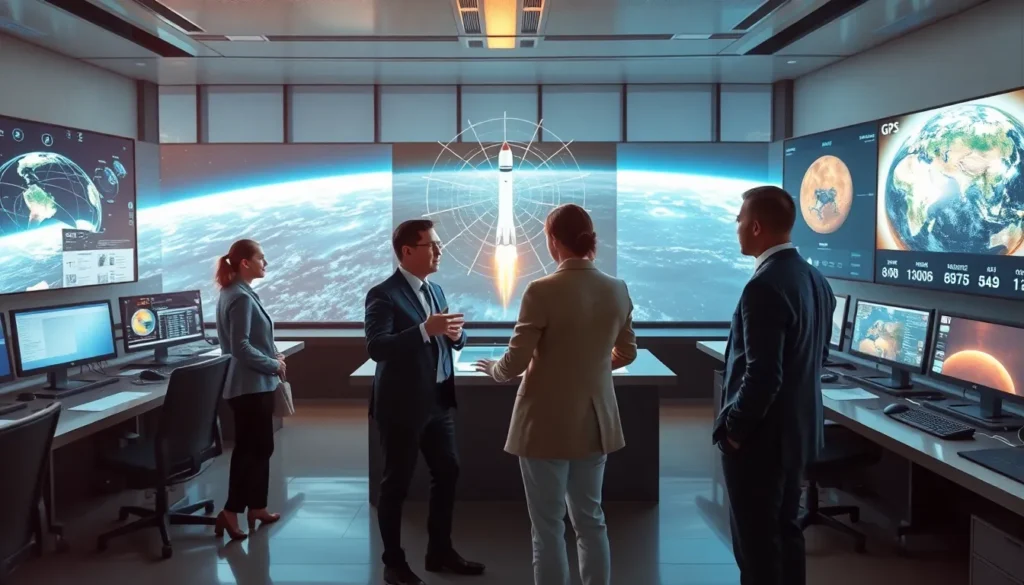

Space technology shapes how humans explore, communicate, and understand the universe. From satellites that deliver GPS signals to rockets that carry astronauts beyond Earth’s atmosphere, space technology drives progress in science, industry, and daily life.
But what is space technology exactly? It refers to the equipment, systems, and engineering methods used to explore outer space and apply space-based capabilities on Earth. This guide breaks down the core types of space technology, explains how it affects everyday activities, and looks at what the future holds for this fast-growing field.
Table of Contents
ToggleKey Takeaways
- Space technology refers to the equipment, systems, and engineering methods used to explore outer space and apply space-based capabilities on Earth.
- Over 10,000 active satellites currently orbit Earth, enabling GPS navigation, weather forecasting, global communications, and scientific research.
- Reusable rockets from companies like SpaceX have reduced launch costs significantly—from $150 million to around $67 million per mission.
- Everyday innovations like portable ultrasounds, water purification systems, and precision farming trace their origins to space technology research.
- The future of space technology includes lunar bases, Mars missions, space tourism, and emerging industries like asteroid mining and in-space manufacturing.
Defining Space Technology
Space technology includes all tools, machines, and systems designed for use in outer space or to support space-related missions. This covers everything from launch vehicles and satellites to space stations, probes, and ground control infrastructure.
At its core, space technology serves two purposes. First, it enables exploration, sending humans and robotic spacecraft to study planets, moons, asteroids, and distant galaxies. Second, it provides practical services on Earth, such as weather forecasting, global communications, and navigation.
The field began in earnest during the mid-20th century. The Soviet Union launched Sputnik 1 in 1957, marking the first artificial satellite in orbit. The United States followed with its own satellites and eventually landed astronauts on the Moon in 1969. Since then, space technology has advanced rapidly. Today, private companies like SpaceX and Blue Origin work alongside government agencies like NASA, ESA, and ISRO to push boundaries further.
Space technology also intersects with other disciplines. Engineers draw on materials science, computer programming, physics, and telecommunications to build systems that survive extreme conditions, intense radiation, vacuum, and temperature swings ranging from -250°F to 250°F.
Understanding space technology matters because its applications reach far beyond rocket launches. Medical imaging, memory foam mattresses, water purification systems, and scratch-resistant lenses all trace their origins to space research. The innovations developed for space often find their way into hospitals, homes, and industries worldwide.
Key Types of Space Technology
Space technology covers a wide range of systems. Two categories stand out for their importance: satellites and communication systems, plus launch vehicles and spacecraft.
Satellites and Communication Systems
Satellites are perhaps the most visible form of space technology in daily life. These machines orbit Earth and perform specific tasks based on their design. As of 2024, more than 10,000 active satellites circle the planet.
Communication satellites relay phone calls, internet data, and television signals across continents. They make global connectivity possible. Without them, international phone calls would require undersea cables for every connection, and live broadcasts from remote locations would be impossible.
Weather satellites monitor atmospheric conditions and help meteorologists predict storms, hurricanes, and temperature changes. Earth observation satellites track deforestation, urban growth, ice melt, and agricultural patterns. GPS satellites, a constellation of about 31 spacecraft, provide location data to billions of devices worldwide.
Military and intelligence agencies also rely on satellites for reconnaissance and secure communications. Scientific satellites like the Hubble Space Telescope and James Webb Space Telescope capture images of distant galaxies and expand our understanding of the universe.
Launch Vehicles and Spacecraft
Launch vehicles are the rockets that carry payloads, satellites, cargo, or crew, from Earth into space. These vehicles must generate enough thrust to overcome gravity and reach orbital speeds of about 17,500 mph.
Traditional rockets like the Atlas V and Delta IV have served for decades. Newer designs from SpaceX, including the Falcon 9 and Falcon Heavy, introduced reusable first-stage boosters. This innovation cut launch costs significantly. A Falcon 9 launch now costs around $67 million, compared to $150 million or more for older expendable rockets.
Spacecraft include crewed capsules like SpaceX’s Dragon and Boeing’s Starliner, along with uncrewed probes sent to explore other planets. The Voyager probes, launched in 1977, continue transmitting data from interstellar space, over 15 billion miles from Earth. Rovers like Perseverance explore Mars, collecting soil samples and searching for signs of past microbial life.
Space stations represent another category. The International Space Station (ISS) has hosted astronauts continuously since 2000. It serves as a laboratory for experiments in microgravity, medicine, and materials science.
How Space Technology Impacts Everyday Life
Space technology influences daily routines in ways most people don’t notice. The smartphone in your pocket relies on space technology for GPS navigation. Weather apps pull data from satellites orbiting hundreds of miles overhead. International video calls travel through communication satellites before reaching their destination.
Agriculture benefits significantly from space technology. Farmers use satellite imagery to monitor crop health, identify irrigation problems, and optimize planting schedules. Precision farming techniques, guided by GPS, reduce waste and increase yields.
Disaster response teams depend on satellite data to assess damage after earthquakes, floods, and wildfires. Real-time imagery helps coordinate rescue efforts and deliver supplies to affected areas.
The financial sector uses atomic clocks on GPS satellites to timestamp transactions. High-frequency trading requires precise timing measured in microseconds. Without space technology, modern financial markets would operate differently.
Health care has gained from space research too. Portable ultrasound devices, insulin pumps, and techniques for remote patient monitoring all emerged from technology developed for astronauts. NASA’s work on water recycling systems for the ISS led to purification methods now used in developing countries.
Even entertainment connects to space technology. Satellite television and radio deliver content to millions. Streaming services route data through networks that rely partly on satellite infrastructure.
Space technology also drives scientific discovery. Telescopes in orbit study cosmic phenomena without atmospheric interference. Data from space missions reveals information about planetary formation, black holes, and the origins of the universe.
The Future of Space Technology
Space technology continues advancing at a rapid pace. Several trends will shape the coming decades.
Reusable rockets are now standard rather than experimental. SpaceX’s Starship, designed for full reusability, aims to reduce costs further and enable missions to Mars. Blue Origin and Rocket Lab are developing their own reusable systems.
Space tourism has moved from concept to reality. Companies like Virgin Galactic and Blue Origin have flown paying passengers on suborbital flights. Orbital tourism, visits to private space stations, could become common within the next decade.
Moon missions are returning. NASA’s Artemis program plans to land astronauts on the lunar surface by the mid-2020s. China and India have also sent missions to the Moon, with plans for crewed landings in the future. These efforts could lead to permanent lunar bases that serve as stepping stones for deeper exploration.
Mars remains a long-term goal. SpaceX founder Elon Musk has stated ambitions to send humans to Mars before 2030. Such missions would require advances in life support, radiation shielding, and propulsion.
Smaller satellites, known as CubeSats and smallsats, are democratizing access to space. Universities, startups, and developing nations can now afford to launch satellites for research and communication purposes.
Space debris presents a growing challenge. With thousands of defunct satellites and fragments orbiting Earth, collisions pose risks to active spacecraft. Companies and agencies are working on debris removal technologies, including nets, harpoons, and lasers.
In-space manufacturing and asteroid mining may emerge as industries. Extracting water and metals from asteroids could support long-duration missions and provide raw materials without the cost of launching them from Earth.


