
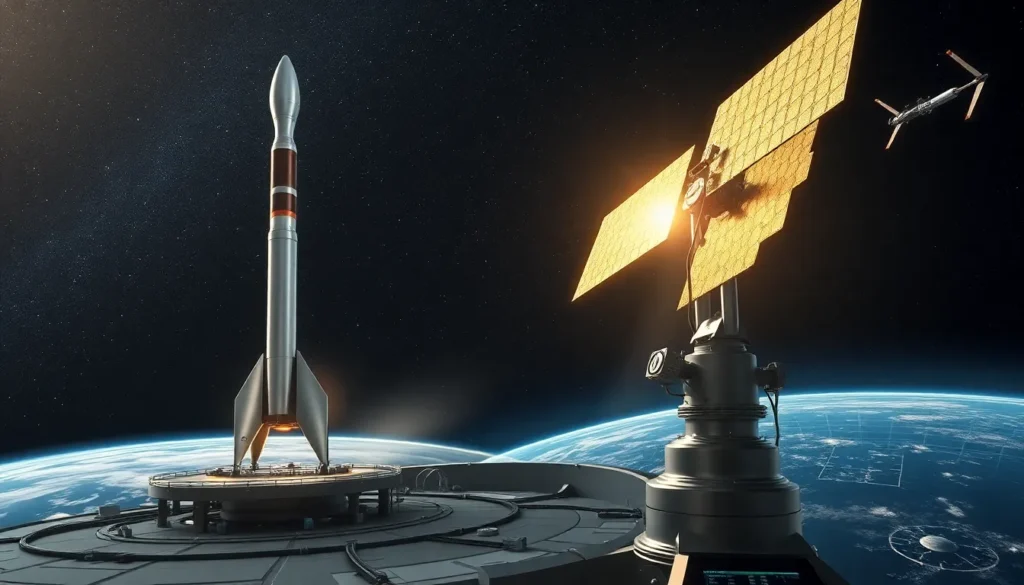

The best space technology available today is redefining what humans can achieve beyond Earth. From rockets that land themselves to satellites that blanket the globe with internet access, space innovation has accelerated at a pace few predicted. These technologies aren’t just impressive engineering feats, they’re practical tools driving scientific discovery, economic growth, and plans for human settlement on other worlds. This article explores the key breakthroughs that represent the best space technology shaping exploration right now.
Table of Contents
ToggleKey Takeaways
- Reusable rocket systems like SpaceX’s Falcon 9 and Starship have slashed launch costs from $400 million to as low as $67 million per mission.
- The best space technology in satellites includes Starlink’s 6,000+ constellation providing global broadband and AI-powered Earth observation for real-time insights.
- The James Webb Space Telescope delivers unprecedented infrared views of the universe, revealing distant galaxies and exoplanet atmospheres like never before.
- In-space manufacturing enables superior products like ZBLAN fiber optics and 3D-printed tools, reducing resupply dependence for long-duration missions.
- Commercial space stations from Axiom Space and Vast Space are expanding humanity’s permanent orbital presence for research, tourism, and manufacturing.
- NASA’s Artemis program and China’s lunar base plans demonstrate how the best space technology is paving the way for sustained human habitation beyond Earth.
Reusable Rocket Systems
Reusable rocket systems represent one of the best space technology achievements of the past decade. Before 2015, nearly every rocket launched into space was discarded after a single use. That changed when SpaceX successfully landed its Falcon 9 booster, proving that rockets could fly again.
The economics here are significant. A traditional expendable rocket costs between $100 million and $400 million per launch. Reusable systems cut those costs dramatically. SpaceX’s Falcon 9 now offers launches at roughly $67 million, and the company has reused individual boosters more than 20 times. Blue Origin has followed suit with its New Shepard and New Glenn vehicles, while Rocket Lab is developing reusable capabilities for its Electron rocket.
SpaceX’s Starship pushes this concept further. Designed for full reusability, both the booster and the spacecraft, Starship aims to reduce per-launch costs to under $10 million eventually. The vehicle stands 400 feet tall and can carry over 100 metric tons to low Earth orbit. NASA has selected Starship as the lunar lander for its Artemis program, demonstrating confidence in the best space technology coming from the private sector.
Reusable rockets have enabled launch cadences that were impossible before. In 2024, SpaceX conducted over 100 launches in a single year. This frequency supports satellite constellation deployment, space station resupply, and scientific missions. The best space technology makes space access routine rather than exceptional.
Advanced Satellite Technology
Satellites have shrunk in size while growing in capability. CubeSats, satellites as small as a loaf of bread, now perform tasks that once required school-bus-sized spacecraft. This miniaturization represents some of the best space technology driving modern space operations.
Starlink leads the satellite internet revolution. SpaceX has launched over 6,000 Starlink satellites, creating a low-Earth-orbit constellation that provides broadband internet to remote areas worldwide. Each satellite weighs about 570 pounds and includes advanced phased-array antennas and autonomous collision avoidance systems. Amazon’s Project Kuiper and OneWeb are building competing constellations, expanding global connectivity options.
Earth observation satellites have transformed agriculture, disaster response, and climate monitoring. Planet Labs operates over 200 imaging satellites that photograph Earth’s entire landmass daily. These images help farmers optimize irrigation, allow emergency responders to assess damage after hurricanes, and give researchers data to track deforestation and ice sheet changes.
The best space technology in satellites also includes on-board processing power. Modern satellites can analyze data before transmitting it to Earth, reducing bandwidth needs and speeding up information delivery. Some satellites now use artificial intelligence to identify objects of interest, ships, wildfires, or infrastructure changes, and alert operators in near real-time.
Navigation satellites continue improving too. GPS III satellites offer three times better accuracy than their predecessors and stronger signals that resist interference. The European Galileo and Chinese BeiDou systems provide additional precision positioning options, supporting everything from smartphone apps to autonomous vehicles.
Space Telescopes and Deep Space Observation
Space telescopes have opened views of the universe impossible from Earth’s surface. The James Webb Space Telescope (JWST), launched in December 2021, represents the best space technology for astronomical observation available today.
JWST observes in infrared wavelengths, seeing through cosmic dust clouds that block visible light. Its primary mirror spans 21 feet, nearly three times larger than Hubble’s. The telescope operates at the L2 Lagrange point, about one million miles from Earth, where its sunshield keeps instruments at temperatures near absolute zero. Since beginning science operations in 2022, JWST has captured images of distant galaxies, analyzed exoplanet atmospheres, and provided new data about star formation.
The Hubble Space Telescope continues contributing after more than 30 years in orbit. Hubble observes in visible and ultraviolet light, complementing JWST’s infrared capabilities. Together, these instruments provide a fuller picture of cosmic phenomena.
NASA’s Nancy Grace Roman Space Telescope, scheduled for launch in 2027, will survey the sky 100 times faster than Hubble. It will map dark energy’s effects, discover thousands of exoplanets, and image galaxies across billions of light-years. This upcoming mission demonstrates how the best space technology keeps advancing.
Deep space probes extend human observation beyond telescopes. The Voyager spacecraft, launched in 1977, continue transmitting data from interstellar space. New Horizons flew past Pluto in 2015 and a Kuiper Belt object in 2019. These missions reveal details about our solar system’s outer regions that no telescope can match.
In-Space Manufacturing and Habitation
In-space manufacturing represents an emerging category of the best space technology with significant potential. Microgravity environments enable production processes impossible on Earth, and several companies are developing commercial space stations to exploit these conditions.
Fiber optic cables produced in space show remarkable improvements over Earth-made versions. ZBLAN optical fibers manufactured in microgravity exhibit fewer defects, potentially increasing data transmission efficiency by 10 to 100 times. Companies like FOMS and Flawless Photonics are testing production methods aboard the International Space Station.
3D printing in space is advancing rapidly. NASA has printed tools, spare parts, and medical supplies aboard the ISS. Redwire’s additive manufacturing facility has produced hundreds of items in orbit. This capability reduces dependence on resupply missions and supports longer crewed missions to the Moon and Mars.
Commercial space stations are taking shape. Axiom Space is building modules attached to the ISS that will eventually separate into an independent station. Vast Space plans to launch its Haven-1 station in 2025. These facilities will host researchers, tourists, and manufacturing operations, expanding humanity’s permanent presence in orbit.
Lunar habitation plans are progressing through NASA’s Artemis program. The Gateway station will orbit the Moon, serving as a staging point for surface missions. Surface habitats will follow, potentially using 3D-printed structures made from lunar regolith. China is developing its own lunar base plans, with construction targeted for the 2030s. These efforts showcase how the best space technology supports long-term human presence beyond Earth.


