
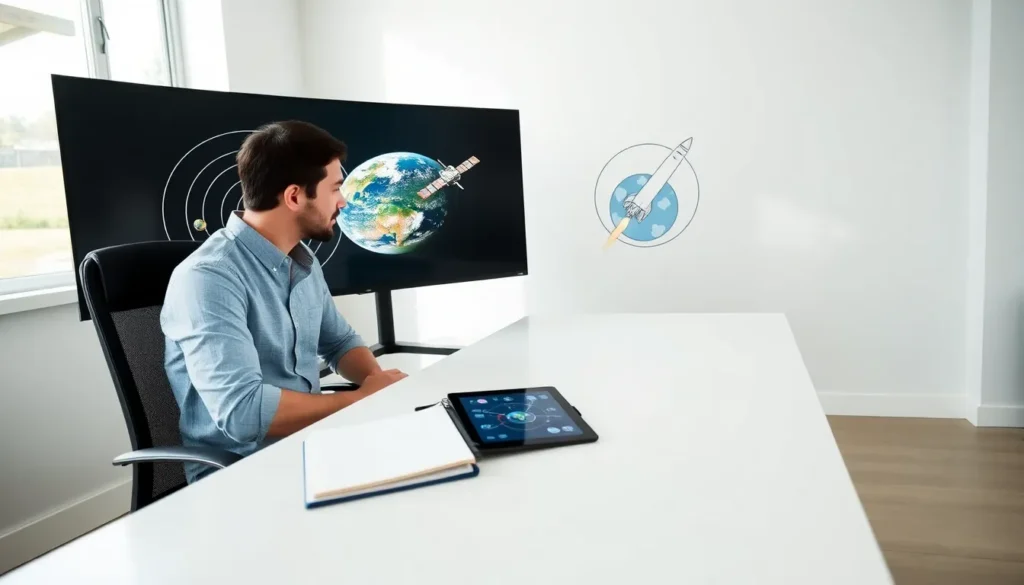

Space technology shapes modern life in ways most people never notice. GPS navigation, weather forecasts, and internet connectivity all depend on systems orbiting Earth. Yet the field can seem distant and complicated to newcomers.
This guide breaks down space technology for beginners into clear, accessible concepts. Readers will learn what space technology actually means, explore its main types, and discover how these systems affect daily routines. Whether someone dreams of a career in aerospace or simply wants to understand the science behind satellite TV, this article provides a solid starting point.
Table of Contents
ToggleKey Takeaways
- Space technology for beginners starts with understanding two main purposes: enabling exploration and providing practical services like GPS, communication, and weather forecasting.
- Satellites are the backbone of modern life—powering navigation, banking systems, agriculture, disaster response, and global entertainment.
- Reusable rockets like SpaceX’s Falcon 9 have reduced launch costs by roughly 90%, making space technology more accessible than ever.
- Free resources from NASA, Coursera, YouTube, and space simulations like Kerbal Space Program make learning about space technology easy for anyone.
- Careers in space technology extend beyond engineering to include law, communications, and business, opening doors for diverse skill sets.
What Is Space Technology?
Space technology refers to any equipment, system, or tool designed to operate beyond Earth’s atmosphere. This includes spacecraft, ground control systems, and the scientific instruments that gather data from distant planets.
The term covers a broad range of innovations. Some space technology stays on the ground, like the massive antennas that communicate with Mars rovers. Other examples orbit Earth continuously, providing services billions of people rely on each day.
Space technology development began in earnest during the 1950s. The Soviet Union launched Sputnik 1 in 1957, marking humanity’s first artificial satellite. Since then, engineers have created thousands of devices that explore, monitor, and connect our world.
For beginners, understanding space technology starts with recognizing its two main purposes. First, it enables exploration, sending probes to asteroids, landing robots on Mars, and studying distant galaxies. Second, it provides practical services like communication, navigation, and Earth observation.
Modern space technology has become remarkably sophisticated. Spacecraft can now travel billions of miles on precise trajectories. Satellites weigh less than a loaf of bread yet perform functions that once required room-sized computers. This miniaturization has opened space technology to universities, startups, and even high school students.
Key Types of Space Technology
Space technology comes in several distinct categories. Each serves specific purposes and operates under different principles. Beginners should focus on two foundational types: satellites and rockets.
Satellites and Their Everyday Uses
Satellites are objects placed into orbit around Earth or other celestial bodies. They perform tasks that would be impossible from the ground.
Communication satellites relay phone calls, television broadcasts, and internet data across continents. Over 3,000 active communication satellites currently orbit Earth. They make global connectivity possible within milliseconds.
Weather satellites photograph cloud formations and track storms. Meteorologists use this data to predict hurricanes days before they make landfall. These warnings save thousands of lives annually.
Navigation satellites power GPS systems. A constellation of 31 satellites enables smartphones to pinpoint locations within a few meters. This space technology guides drivers, helps hikers find trails, and allows delivery companies to optimize routes.
Earth observation satellites monitor environmental changes. They detect deforestation, measure ice sheet thickness, and track pollution levels. Scientists rely on this data to study climate patterns.
Rockets and Launch Systems
Rockets provide the thrust needed to escape Earth’s gravity. Without them, no satellite or spacecraft could reach orbit.
Modern rockets use liquid or solid propellants. Liquid-fueled rockets offer more control and can be throttled or shut down mid-flight. Solid rockets provide simpler, more reliable ignition but cannot be stopped once lit.
Launch systems have evolved dramatically. SpaceX’s Falcon 9 rocket lands itself after delivering payloads to orbit. This reusability has cut launch costs by roughly 90% compared to earlier decades.
Smaller rockets now serve the growing small satellite market. Companies launch dozens of satellites on single missions. This efficiency makes space technology accessible to organizations that couldn’t afford launches in the past.
How Space Technology Impacts Daily Life
Space technology touches everyday activities in surprising ways. Most people use satellite-dependent services dozens of times daily without realizing it.
Banking systems synchronize transactions using atomic clocks aboard GPS satellites. Without this precise timing, ATM networks and stock markets would struggle to function correctly. Space technology literally keeps the global economy running smoothly.
Agriculture benefits enormously from orbital systems. Farmers use satellite imagery to identify crop diseases, monitor soil moisture, and optimize irrigation. Precision agriculture techniques reduce water waste and increase yields.
Disaster response teams depend on space technology during emergencies. Satellites provide communication when ground infrastructure fails. They also generate damage maps within hours of earthquakes or floods, helping responders prioritize rescue efforts.
Aviation relies heavily on satellite navigation. Pilots use GPS to fly more direct routes, saving fuel and reducing emissions. Air traffic controllers track thousands of aircraft simultaneously using satellite data.
Even entertainment owes much to space technology. Streaming services deliver content through satellite backbones. Sports broadcasts reach billions of viewers via orbital relay stations. Live news coverage from remote locations travels through space before reaching home screens.
Climate science would be nearly blind without satellites. They measure sea levels, track glacier retreat, and monitor atmospheric carbon dioxide. This data informs policy decisions affecting entire nations.
Getting Started With Learning About Space
Beginners have more resources than ever for learning about space technology. The internet offers free courses, documentaries, and interactive tools.
NASA’s website provides extensive educational materials. Their explanations cover everything from basic orbital mechanics to current Mars missions. The agency also streams rocket launches and spacewalks live.
Online learning platforms offer structured courses. Coursera and edX host programs from universities like MIT and Caltech. Many courses are free to audit, making space technology education accessible globally.
YouTube channels dedicated to space provide engaging introductions. Creators like Scott Manley and Everyday Astronaut explain complex concepts in plain language. They cover launches, satellite technology, and spacecraft design.
Local astronomy clubs offer hands-on experience. Members often share telescopes and knowledge freely. These groups introduce beginners to the night sky and the technology used to study it.
Space technology simulations let users experiment virtually. Software like Kerbal Space Program teaches orbital mechanics through gameplay. Players design rockets, plan missions, and learn from spectacular failures.
Following industry news keeps learners current. Websites like SpaceNews and Ars Technica cover launches, policy changes, and technological breakthroughs. Social media accounts from space agencies offer real-time updates.
For those seeking careers in space technology, STEM education provides the foundation. Engineering, physics, and computer science degrees lead to aerospace positions. But, the industry also needs lawyers, communicators, and business professionals.


